Krabi's boat days all live or die on the Andaman being calm. Ao Thalane does not. It is a maze of tidal mangrove channels and limestone canyons about 30 km north of Ao Nang, on water enclosed enough that an open-sea swell never reaches it – which makes a half-day kayak the one booking on this coast a bad forecast cannot take away from you, and the honest answer to what to do in Krabi when it rains.
Why the weather argument actually holds
This is not a marketing claim, it is geography. Ao Thalane sits in a deep inlet in Ao Luek district, screened from the open Andaman by headlands and a wall of karst, and most of the route is inside mangrove channels narrow enough to touch both banks. Wind has no fetch to build a wave in there.
So when the harbormaster suspends sailings and the 4 Islands and Hong Island boats stop, this still runs. Rain makes it wet, which on a kayak in 30°C is close to irrelevant, and the mangrove canopy takes the worst of a downpour.
The one thing that does stop it is a genuine storm, and the one thing that changes it every single day is the tide.
What you paddle through
The route is usually described as mangroves, which undersells it – there are three distinct landscapes in about two hours of paddling and roughly 5 to 7 km.
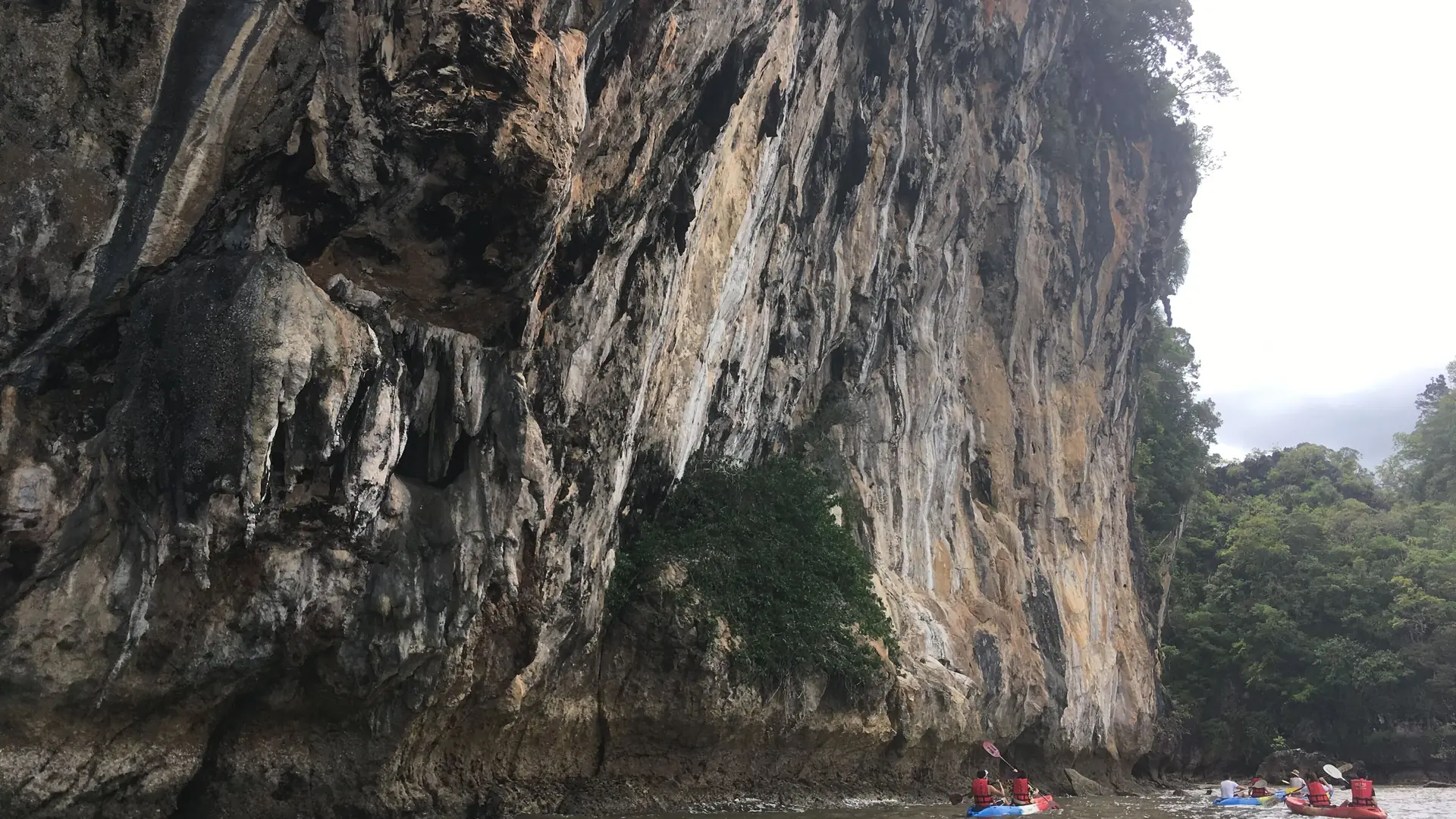
The channels come first: tunnels of mangrove with the roots arching overhead, dim and quiet, wide enough for one kayak in places. The canyons open out next, where the water runs between limestone walls hundreds of meters high and the sound changes completely. The caves and overhangs are last, huge weathered hollows in the base of the karst that you paddle under rather than into.
The wildlife is genuinely part of it rather than a brochure line. Kingfishers and little herons are near-certain, and crab-eating macaques work the mudflats at low water. Monitor lizards are common; gibbons are heard far more often than seen.
You are in a sit-on-top kayak with a guide, usually two to a boat, and it needs no experience or particular fitness. This is a paddle, not an expedition.
The tide decides which Ao Thalane you get
Here is the thing almost no listing explains, and it matters more than which operator you pick.
At high tide the water is up in the mangroves and the network opens. More channels are passable, you can get further under the overhangs, and the lagoons walled inside the karst are reachable – the enclosed pools that are the best thing here are only accessible when the water is high enough to float you through the gap.
At low tide the mangrove roots stand clear of the water, which turns the channels into a strange stilted labyrinth that photographs better than it paddles. It is still a good trip. It is a smaller one, and the lagoons are usually off the table.
Neither is wrong, and both are sold as the same product at the same price. What follows is simple: morning and afternoon departures are not interchangeable, and which one is better shifts by about 50 minutes a day as the tide does. If the lagoons are why you are going, ask the operator which slot lands on the high water for your date and book that one, rather than assuming the morning is the good one.
Klong Root, the freshwater version, and the ATV problem
If the sea is genuinely closed or you have already done Ao Thalane, the other Krabi paddle is inland and completely different. Klong Root – also written Khlong Nam Sai, and sold as the Crystal Lagoon – is a spring-fed freshwater canal about 18 km from Krabi Town, where the water runs clear enough to watch fish under the hull the whole way.
It is roughly 2 km of paddling, 30 to 45 minutes, to reach the lagoon and the spring at the end. Sessions typically run at 08:30 and 13:30 with pickups from Ao Nang, Ao Nam Mao, Krabi Town and Klong Muang. It is calm, shaded and about as weather-proof as outdoor activity in Thailand gets.
The catch is what it gets sold with. Most Klong Root listings on the booking platforms bundle the paddle with an ATV circuit, a zipline, horse riding or an elephant-care stop, which is how a $13 headline price happens. If you want the kayak and nothing else, read the inclusions rather than the title, because the clean kayak-only version exists and is not always the one ranking first. There is also a small on-site gate fee, around 50 baht for foreign adults, plus a per-kayak charge, separate from any tour price.
The Emerald Pool, briefly
The other answer to a washed-out day is the Emerald Pool (Sa Morakot) and the hot springs at Khlong Thom, mineral-fed pools in the Thung Teao Forest reserve. Two things to know before you commit a day to it: it is roughly 70 km from Ao Nang, about 90 minutes each way, and the entry fee is 400 baht per foreign adult, 200 per child, on top of whatever transport you arrange. Only the Emerald Pool is swimmable; the neighboring Blue Pool is not.
It is a good half-day and it is not a water activity in the sense the rest of this site uses. There is no strong guided product to recommend – most people go by minibus tour or hired car – so treat it as a drive to a swimming spot rather than a booking decision.
When to go, and where it fits
November to April is the best of it – clearer water at Klong Root, better light in the canyons, more wildlife moving.
May to October is when this article earns its place. The kayak is the trip you move to when the islands are off, and in the monsoon months that happens often enough to be worth planning around rather than reacting to. Prices are lower and the mangroves are at their greenest.
The rest of the Krabi water menu is sea-dependent by comparison: the 4 Islands tour is the beach and sandbar day, the Hong Islands put you inside a lagoon reached across open water, Phi Phi from Krabi is the long crossing, and the sunset and plankton cruise needs a calm evening and a dark sky. A kayak morning pairs well with any of them and rescues the week when none of them can sail.
For a base that makes the early pickups painless, see Krabi's beachfront resorts; for somewhere to dry off slowly afterward, its private pool villas.
FAQ – kayaking at Ao Thalane
Images: Christophe95 / Wikimedia Commons / CC BY-SA 4.0