Every 4 Islands tour out of Ao Nang calls at the same four places – Phra Nang Cave Beach, Chicken Island, Tup Island and Poda Island – which means the itinerary is not the decision. The boat is. A longtail takes 20 to 30 minutes to reach the outer islands where a speedboat needs under ten, and costs roughly half. Both add a 400 baht national park fee, in cash, on the day.
The four islands, and what each one is actually for
They get sold as a set, but they do four different jobs and only one of them is a proper beach day.
Phra Nang Cave Beach is on the Railay peninsula rather than an island at all – a strip of sand under an overhanging cliff, reachable only by boat because the karst wall behind it has no road. The cave at the end holds a fertility shrine to a sea princess, decorated with carved wooden phalluses left as offerings by fishermen. It is the busiest stop on most itineraries and the one people photograph.
Chicken Island (Koh Kai) is named for the rock spire at its tip that reads, with some goodwill, as a chicken's head and neck. The snorkeling here is the best of the four, and the beach stays quieter than Poda because most boats stop offshore rather than land.
Tup Island (Koh Tup) is small, low and edged in very fine white sand. It exists on the itinerary for one reason – it is one end of the sandbar, and at the right state of tide you can walk off it.
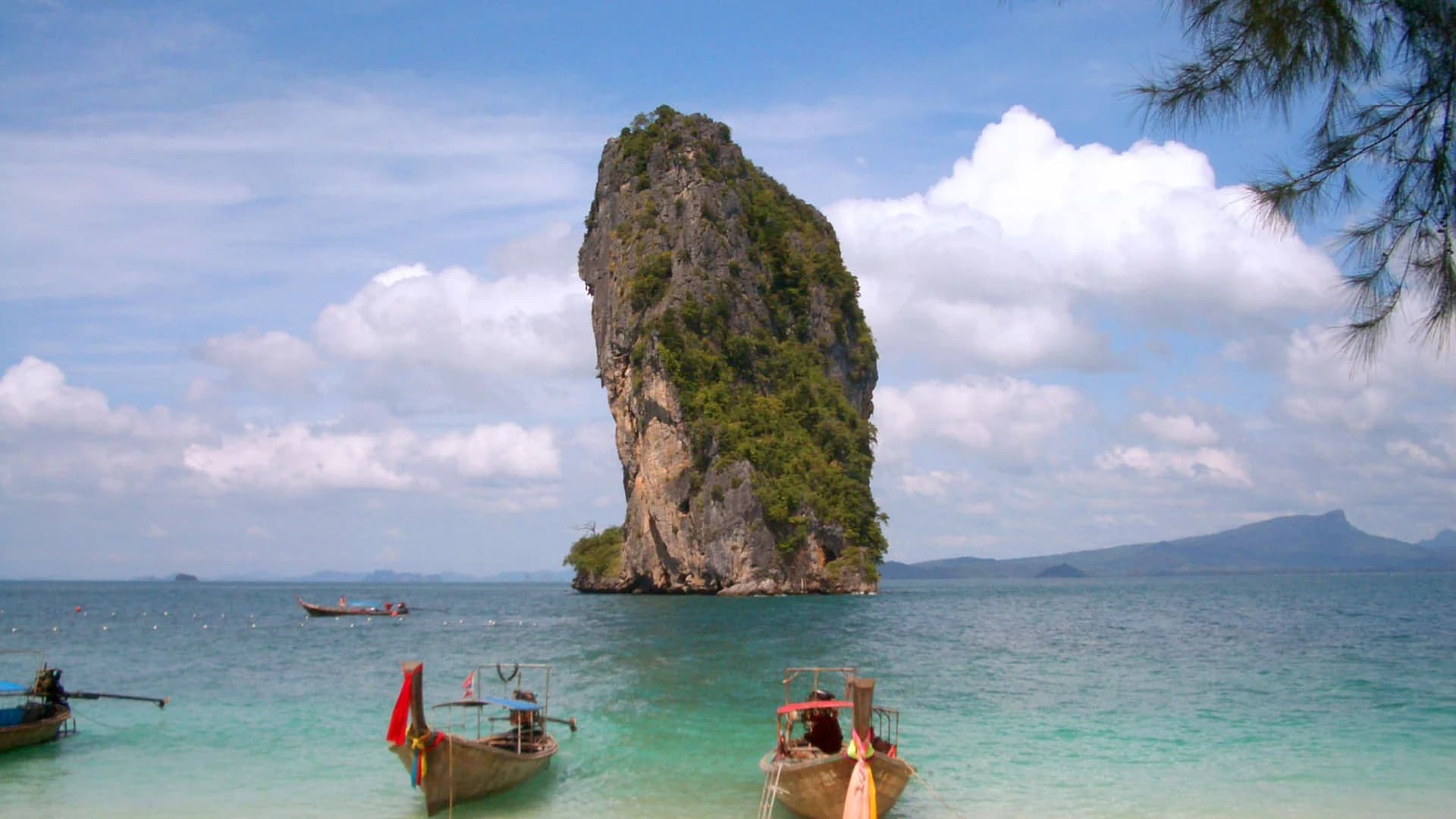
Poda Island is the lunch stop and the picture-postcard one: a long soft beach with a limestone tower standing in the water offshore. It also takes the most people at once, so if crowds are what spoil a beach for you, this is the stop to spend least time on.
Longtail or speedboat: the decision that changes your day
Krabi's 4 Islands market sells both, and the choice is worth making deliberately rather than defaulting to whichever is cheaper. Some listings even let you pick the boat at checkout.
| Longtail boat | Speedboat | |
|---|---|---|
| Ao Nang to the outer islands | 20–30 minutes | under 10 |
| Typical day | around 6.5 to 7 hours | around 7 hours, often with an extra snorkel stop |
| Booked locally | roughly 500–800 baht | roughly 1,000–1,500 baht |
| In chop | slow and wet, but you feel the sea | fast and wet, and it slams |
| What you are buying | the boat itself, and a slower day | time ashore, and more of it |
Take the longtail if the boat is part of why you came. A longtail is a working Thai fishing hull with a car engine bolted to a pole, an open deck and a canvas roof, and it moves at a pace that lets the karsts change shape as you pass them. It is loud in a way photographs never convey. It is also the cheaper ticket by a clear margin, and on a route this short the extra transit time costs you perhaps 45 minutes across a whole day.
Take the speedboat if you are traveling with children, or in the wet season. The saved transit converts directly into beach time, which matters when someone in the group runs out of patience before the third stop. From May to October it also matters that a speedboat can outrun a squall the longtail has to sit through.
What the boat does not change is the crowd. Both types leave Ao Nang in the same morning window and arrive at Poda within the same hour, so if you want any of these beaches quiet, the lever is an afternoon or late departure rather than a faster hull.
Thale Waek: the sandbar is a tide, not a place
The photograph that sells this tour – people walking on white sand with sea on both sides – is real, and it is not available every day.
Thale Waek, the "separated sea", is a sand spit that links Koh Kai, Koh Tup and Koh Mor and only stands above water at low tide. At its fullest it runs a few hundred meters, firm enough to walk without wading, and the crossing between islands takes a couple of minutes. Then the tide turns and it is gone.
Two things follow. The lowest tides of the month fall around the new and full moon, so a trip booked within about five days either side has the best odds. And within a day, arriving half an hour before low water is better than arriving at it – you get to watch the sand widen instead of finding it already shrinking.
No operator can promise you the sandbar, because the tide table decides. If walking it is the whole point of your booking, check the Krabi tide times for your dates before you pick which morning to go.
Ao Nang to Railay, the 15-minute boat everyone asks about
Phra Nang Cave Beach sits on the Railay peninsula, and plenty of people who go there on a 4 Islands tour want to come back and stay. There is no road, so the answer is always a boat.
Shared longtails run from Ao Nang beach to Railay in 10 to 15 minutes for 100 baht one way. They are not scheduled: a boat leaves when it has about eight passengers aboard, which in high season is a few minutes' wait and in low season can be considerably longer, or a matter of paying for the empty seats yourself.
The boat club's posted hours are 08:00 to 18:00. Boats do keep running later, but rarely, and the ticket booth closes at 18:00 – so after dark you pay the boatman directly and the fare rises to 150 baht. If you are on Railay for sunset, agree the return with a boatman before the light goes.
You board and land in shin-deep water off the sand at both ends, not at a jetty. Dry bags earn their money on this crossing, and so do shoes you do not mind soaking.
Four islands or seven?
Both are sold from the same beach and they are not competing versions of one trip.
The 4 Islands tour is the daytime one, roughly 09:00 to 15:00, built around beaches and snorkeling. The 7 Islands tour is the evening one, roughly 13:00 to 20:00, which trades two of the busy stops for a sunset, a BBQ on a beach and a swim among bioluminescent plankton after dark. If you are choosing between them, you are really choosing between a beach day and an evening. Doing both on consecutive days is a common and sensible plan, and we cover the evening version in the Krabi sunset and plankton cruise guide.
When to go, and what else Krabi puts on the water
November to April is the Andaman dry season and the right window – calm water, good visibility, the sandbar reliably readable. December to February is the busiest and priciest part of it.
May to October is workable, which is a genuine Krabi advantage. The 4 Islands, unlike Maya Bay, stay open all year – there is no annual closure on this route – and the trips run through the monsoon in all but the roughest weather, when the park authorities or the harbormaster suspend access for a day or two at a time. The whole circuit was shut for four days in September 2024 on a swell above 4 meters, so a wet-season booking is worth confirming the morning of. Prices soften and the beaches thin out, and rain arrives in short heavy bursts rather than all day.
If the sea is closed or the forecast is ugly, Krabi's sheltered water is the answer rather than a lost day: kayaking the mangroves and sea caves at Ao Thalane happens on protected inland water that a swell never reaches. For the two other big boat days, the Hong Islands sit in a different national park with a different fee and a lagoon you enter through the cliff, and Phi Phi from Krabi is the longer crossing to the famous group – closer from here than it is from Phuket.
For a base within walking distance of the Ao Nang boats, see our guides to Krabi's beachfront resorts and its private pool villas.
FAQ – the Krabi 4 Islands tour
Images: Jason Hutchens / Wikimedia Commons / CC BY 2.0