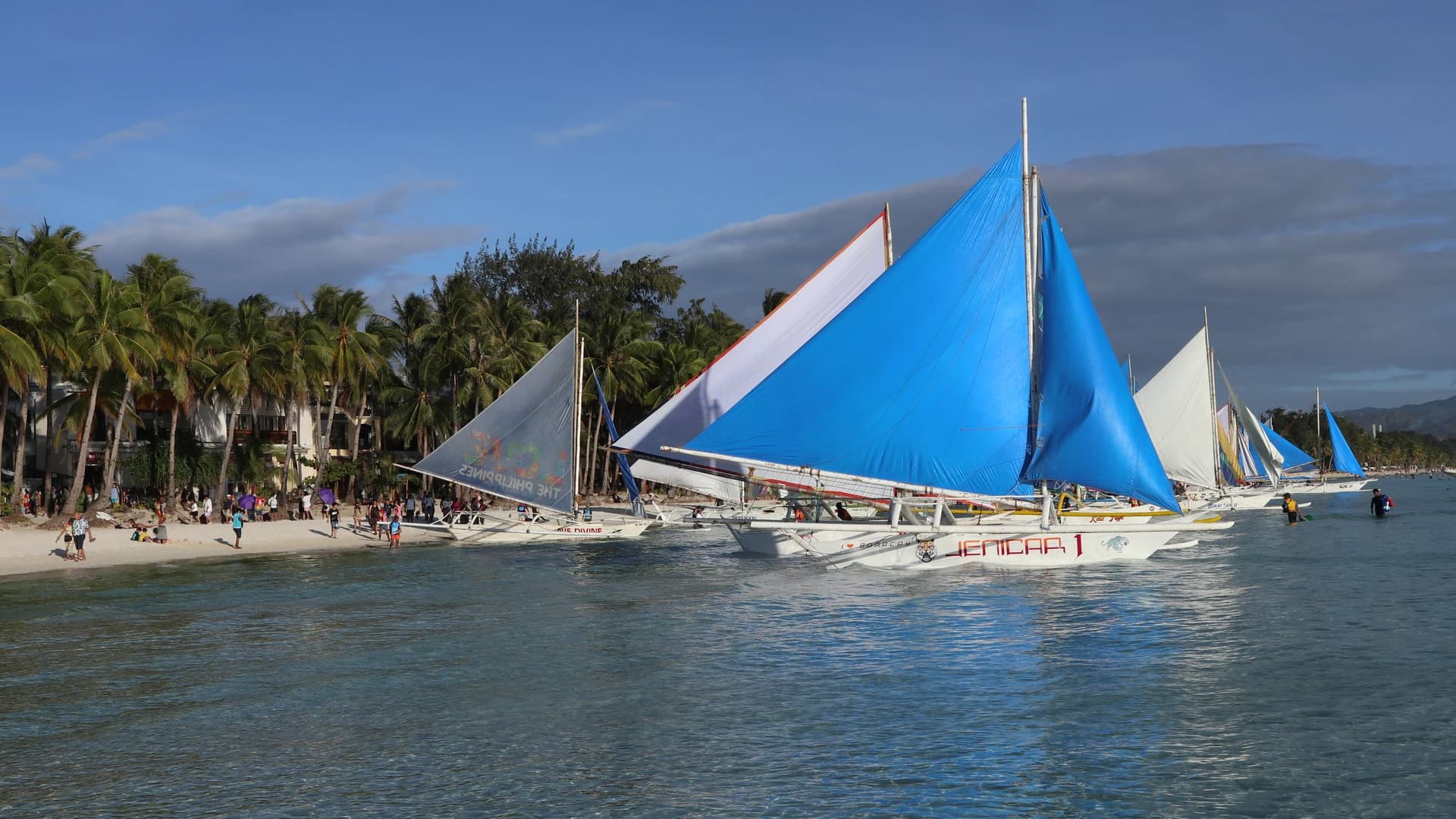
The white-sailed boats in every Boracay photograph are paraw – a traditional Visayan sailing craft, not a tourist catamaran built to look old. A paraw has three parts: the bangka, or main hull, the katig, the twin outriggers, and the layag, the sails. The outriggers do the work a heavy keel would do on a Western boat, which is why the whole thing is light, shallow and quick in very little wind.
What a paraw actually is
The paraw is a double-outrigger sailing boat from the Visayas, used for centuries to fish and to move people and cargo between islands. It is still raced competitively – the Iloilo Paraw Regatta has run annually since 1973 – and the Boracay sunset trips use the same design rather than a replica of it.
The engineering is the interesting part, and it is genuinely elegant. Because the two katig outriggers provide the stability, a paraw does not need a heavy keel to stay upright. A Western monohull carries ballast low in the water to counteract the force on its sails; a paraw achieves the same result with two bamboo floats held out on either side. That removes a great deal of weight, so the hull sits shallow and accelerates in wind that would barely move a keelboat.
Traditionally the hull was cut from Philippine hardwoods such as lawaan or molave, with parts lashed using rope made from abaca fiber; modern working boats commonly use plywood. The layag is typically a crab-claw or lateen-style sail set on a vertical and a horizontal spar – the shape that makes the silhouette recognizable from the beach.
That is worth knowing before you board, because it reframes the ride. You are not on a boat dressed up as heritage. You are on the actual regional design, doing what it has always done.
Thirty minutes, and why that is the right length
A Boracay sunset paraw trip lasts about 30 minutes and departs in the late afternoon, typically around 17:00 to 17:30 depending on the season. Day sails run closer to an hour. Boats carry roughly ten passengers plus crew, and there is no food, no drinks and no engine.
Half an hour sounds short for around $14, and on a per-hour basis it is the most expensive water activity on the island. That comparison misses what the product is. You are paying for the boat and the light, not for time – the trip is timed so that the entire ride sits inside the golden hour, with White Beach on one side and open water on the other.
There is also a practical reason not to want longer. A paraw is an open craft with no shade, no facilities and a hull you sit low in, often with spray. It is a superb thirty minutes and would be a mediocre two hours. The length is a design decision, not a shortcut.
Paraw or the sunset cruise
Both watch the same sunset from the same water. Everything else differs.
| Paraw sailing | Sunset cruise | |
|---|---|---|
| Propulsion | wind only | engine |
| Duration | about 30 minutes | roughly 2–3.5 hours |
| Price | about $14 | about $12 |
| On board | nothing | welcome drink, pica-pica, music |
| Passengers | around 10 | varies, can be large |
| What it is | a short ride on a heritage craft | an evening out |
Book the paraw if you want the photograph and the sail. It is quiet, it is fast in the right breeze, and the boat itself is the reason to go. This is also the better choice with children, who tend to find thirty minutes about right and two hours about ninety minutes too long.
Book the cruise if you want an evening rather than a moment. More time, drinks, music, and a lower price for far more hours on the water.
The two are cheap enough to do on separate evenings, and doing so is a reasonable plan rather than an indulgence.
The season that decides the sail
Amihan, the northeast monsoon, typically runs from around October into February or March and brings the steady, dry breeze the west coast sails best in. Habagat, the southwest monsoon from roughly June to September, drives wind and swell straight onto White Beach, and sunset departures are regularly cancelled through it. PAGASA, the Philippine weather agency, declares the onset and end of each season each year, so the months move.
Amihan is therefore the paraw season, and it happens to coincide with the calmest, driest stretch of the year on the sunset side of the island. If your trip falls in Habagat, book the sail anyway but do it on your first clear evening rather than saving it for the last night.
Where it fits in a Boracay week
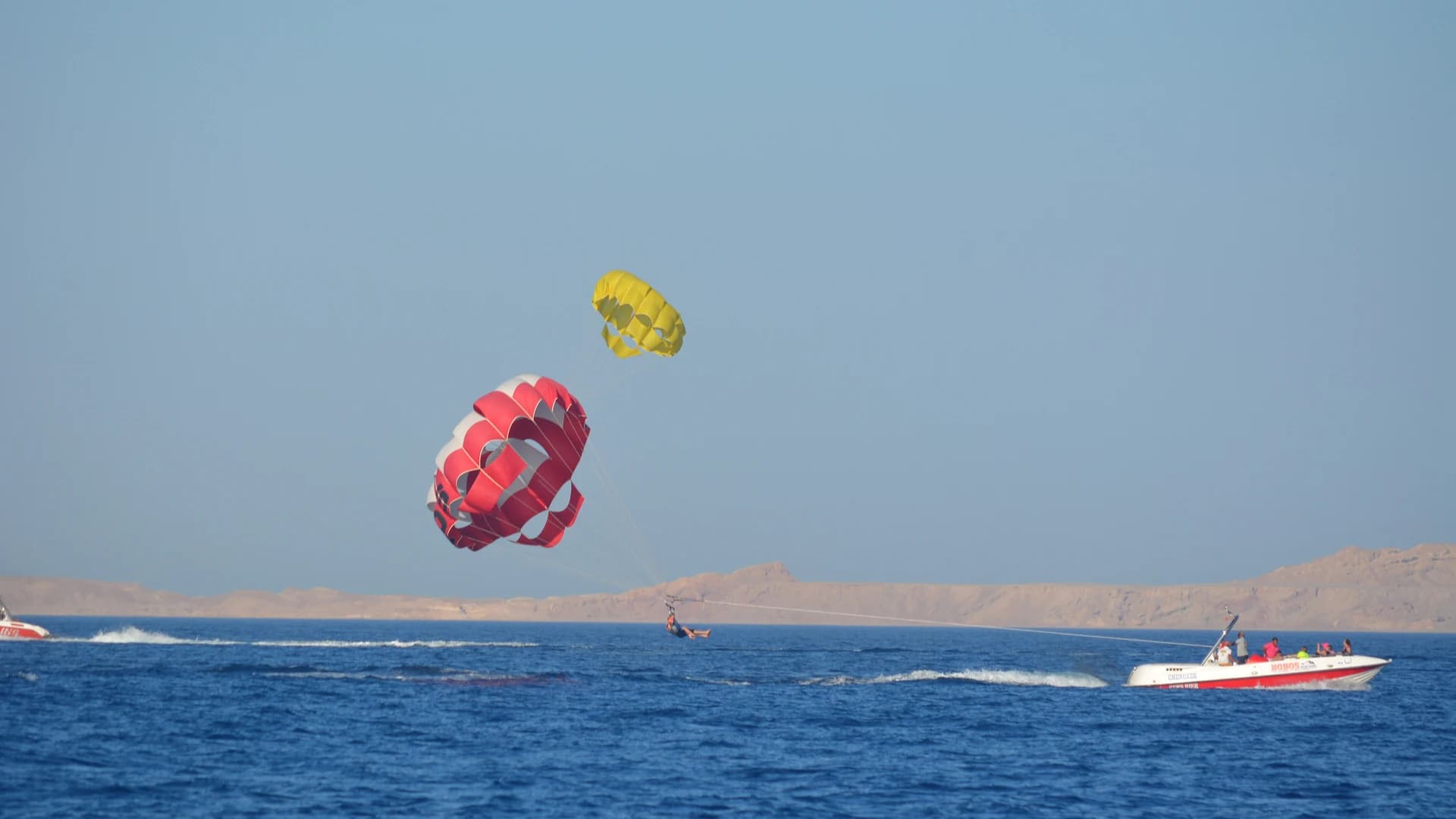
The paraw is the shortest of Boracay's evening water trips and the easiest to fit around anything else. The sunset cruise covers the same evening at length and with a bar; the island hopping tour takes the daylight half of the equation, running three to four stops including Crystal Cove and Puka Beach for around $14. And for a shorter morning thrill, parasailing, helmet diving and jet ski sessions all run from offshore stations off White Beach.
Notably, the island hopping boats are also bangka – the same outrigger hull as the paraw, fitted with an engine instead of a sail. Doing both is a neat way to see what the design does in each configuration, which is more interesting than it sounds once you have been on one.
If you have one evening in Boracay and a camera, book the paraw above. It is thirty minutes, it is the island's own boat, and it is the shot everyone comes back with.
Our guides to Boracay's private pool villas, swim-up rooms and beachfront resorts cover which stretch of White Beach each resort sits on – relevant here, since the paraw departs from that side.
FAQ – paraw sailing in Boracay
Images: Patrickroque01 / Wikimedia Commons / CC BY-SA 4.0