You do not need to be able to swim to helmet dive in Boracay, because at no point are you swimming. A weighted helmet with air pumped down from the surface keeps you upright and breathing normally while you walk along the seabed at about 4 to 5 meters. Your head stays dry the whole time. The activity was built for people who wanted to see a reef and could not, or would not, put their face in the water.
The physics, and why your face stays dry
The helmet works on the same principle as pushing an upturned glass into a sink: the air inside cannot escape because the water pressing up against it holds it in place. The helmet is open at the bottom and sealed at the top, and water pressure traps a pocket of air around your head while a hose feeds fresh air down from a compressor on the boat above.
That single design fact explains almost everything else about the activity. You breathe normally through your nose and mouth rather than through a regulator. Your face never gets wet, so you can wear glasses and keep your hair dry. And because the helmet is heavy – its weight is what keeps you standing on the seabed rather than floating – you have no need to swim, tread water or control your buoyancy.
Air is pumped in continuously at well above what a person actually breathes, reported by operators at around three times normal demand, which also means the supply is not something you can exhaust the way a scuba tank can be. The excess simply escapes around the bottom rim of the helmet.
What the supervision actually is
This is the part worth knowing before you decide whether the activity is for you, because "walking on the seabed" sounds more solitary than it is.
One to two dive instructors are in the water with the group for the whole dive, guiding people down the ladder, positioning them, and watching for discomfort. Operators on this route commonly staff the activity with PADI-qualified instructors. You are not sent down and collected later – somebody is beside you at 4 meters for the full 15 minutes.
The depth is the other reassurance. At 4 to 5 meters you are shallower than the deep end of many hotel pools, close enough to the surface that daylight is strong and the ascent is short. Helmet diving requires no certification because it does not put you in the situations a certification exists to handle.
The genuine discomfort is not drowning – it is your ears. Descending 4 meters produces real pressure on the eardrums, and the fix is the same as on an aircraft: pinch your nose and swallow or blow gently. Instructors brief this before you go in. If your ears will not clear, tell the instructor and go back up. That is a normal outcome, not a failed dive.
Operators screen for medical conditions, and anyone with ear or sinus problems, heart or respiratory conditions, or who is pregnant should expect questions or a refusal. Answer them honestly on the booking form rather than at the ladder.
Helmet diving is not snorkeling
These get confused constantly, and they are close to opposites.
| Snorkeling | Helmet diving | |
|---|---|---|
| Where you are | at the surface, face down | on the seabed, upright |
| Face | in the water | dry |
| Swimming | required | not required |
| Glasses | not possible | fine |
| Depth | surface | about 4–5 m |
| Duration | as long as you like | about 15 minutes |
If you already snorkel comfortably, helmet diving may underwhelm you – you will see similar fish at similar depths with less freedom to move, and the snorkeling stop on the standard island hopping tour is included in a $14 ticket rather than sold separately.
If you do not swim, or you wear glasses, or you simply dislike putting your face in water, helmet diving is the only one of the two that works for you. That is the whole reason the product exists, and at around $13 it is the cheapest way to get properly underwater in Boracay.
What the day actually looks like
The dive is short, but the outing around it is longer. A boat takes the group out to the dive platform, people go down in small batches because the instructor ratio limits how many can be handled at once, and there is waiting on deck either side of your turn.
Budget a couple of hours for something that puts you underwater for fifteen minutes, and treat the photographs as part of the product – most operators include or upsell an underwater photo set, since you cannot bring your own camera down easily.
Several Boracay operators bundle helmet diving with parasailing and a jet ski session as a combined watersports package. If you want more than one of the three, the package is almost always cheaper than three separate bookings and puts them in a single trip out to the same offshore station.
Where it fits in a Boracay week
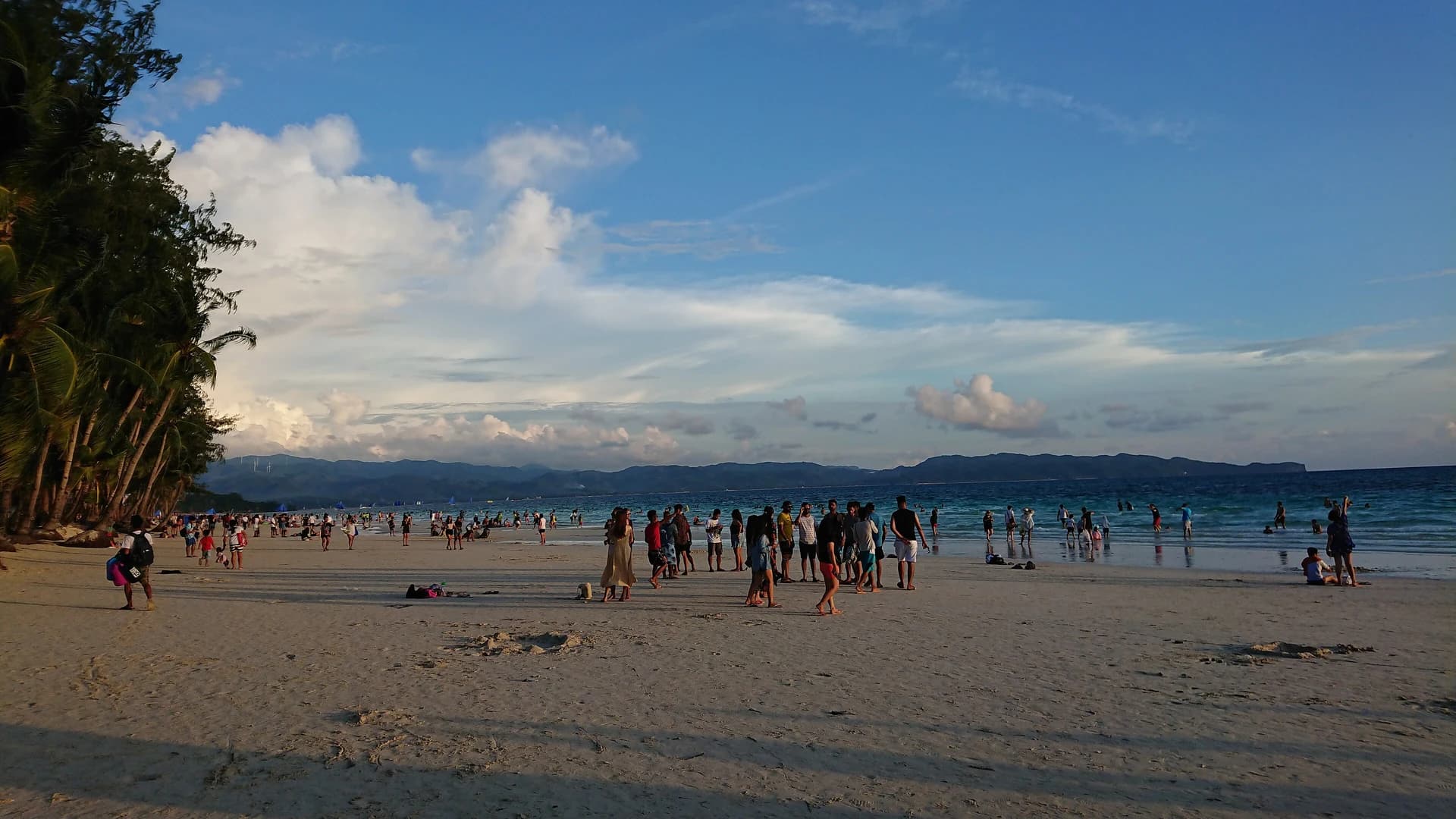
Boracay's activities divide into boats and thrills. The boats are island hopping by day and sunset cruises or paraw sailing in the evening. The thrills are short, offshore, and easy to stack: this, the 15-minute parasailing flight, and the jet ski.
Book the helmet dive above if there is anyone in your group who has been quietly sitting out the snorkeling. At around $13 it is the cheapest activity on this list, it needs nothing from them except the ability to walk, and it is the one that tends to change how people feel about the sea.
Our guides to Boracay's private pool villas, swim-up rooms and beachfront resorts cover where along the coast each resort sits.
FAQ – helmet diving in Boracay
Images: Tirakatol / Wikimedia Commons / CC BY-SA 4.0